Showing posts with label Gulf Coast Restoration. Show all posts

Sunday, July 16, 2017

Time to comment on priorities for restoring the Gulf, says RESTORE Council

The BP oil spill that began on April 20, 2010 and lasted 87 days, gushed 200 million gallons of crude oil into the Gulf of Mexico off the coast of Louisiana. Further tarnishing the ecosystem occurred following generous air drops of the dispersant Corexit around the area of Barataria Bay and in other affected regions, called "zones". Birds, turtles, dolphins, and people were sickened by the horrific spill and the dispersant effects. Coral in the Gulf is still suffering, an additional pummeling besides the blight of climate change.
Now it's time for people in the Gulf, those most affected by this disaster, to voice their pain and share their experiences.
The Gulf Coast Ecosystem Restoration Council has announced the availability of the Draft 2017 Funded Priorities List: Comprehensive Commitment and Planning Support in accordance with the Resources and Ecosystems Sustainability, Tourist Opportunities, and Revived Economies of the Gulf States Act (RESTORE Act).
"In the draft CPS FPL, the Council proposes to provide its members with funding to enhance collaboration, coordination, public engagement and use of best available science needed to make efficient use of Gulf restoration funds resulting from the Deepwater Horizon oil spill. These awards will support the Council’s commitment to a coordinated approach to ecosystem restoration, as called for in the Comprehensive Plan Update 2016: Restoring the Gulf Coast’s Ecosystem and Economy. The draft CPS FPL is now available for public and Tribal review and comment at www.restorethegulf.gov," they wrote in a press release issued July 13.
To ensure consideration, the Council must receive written comments on the 2017 Draft Funded Priorities List: Comprehensive Commitment and Planning Support by 11:59pm MT August 14, 2017.
Further, the second of two informational webinars will be conducted July 25 (the first was on July 13). You may register for the webinar in advance. Once registered, a link to access the webinar will be sent to the email address you provide: July 25, 2017 at 2:00 pm Central Time [Webinar Registration Link]: https://register.gotowebinar.com/register/6303399390784342017
Please Note: all questions and comments typed will be considered as a public comment and will be part of the public record. This includes your name, e-mail, and any other information you provide.
Attendees will not have the ability to ask questions orally. When answering these questions, Council staff will not identify the participant asking the question(s). Council staff will provide written responses to all questions as part of the response to public comments.
HOW TO COMMENT: You may submit public comments via the following methods: Electronic Website Submission: www.restorethegulf.gov Email: frcomments@restorethegulf.gov Mail/Commercial Delivery to: Gulf Coast Ecosystem Restoration Council Attention: Draft FPL Comments Hale Boggs Federal Building 500 Poydras Street, Suite 1117 New Orleans, LA 70130
FOR ADDITIONAL INFORMATION: Please send questions by email to RestoreCouncil@restorethegulf.gov, or contact Keala J. Hughes at (504) 717-7235.
Photo: Courtesy of Wikimedia Commons Images - Washing an oiled gannet, a victim of the BP oil spill, May 1, 2010

Monday, April 3, 2017

Restore Council approves BP spill Louisiana State expenditure plan for $811.9M

The Gulf Coast Ecosystem Restoration Council Chair, U.S. Department of Agriculture, has approved the Louisiana State Expenditure Plan. The Council chair has found the Louisiana SEP is complete and meets all requirements contained in the RESTORE Act, the Department of the Treasury’s implementing regulations, and the Council’s SEP Guidelines, according to a press release issued today.
The USDA provided Louisiana with a letter of approval, reiterating the Council’s commitment to ensuring an efficient and effective process for funding the activities in Louisiana. More information regarding the projects funded with the BP oil spill award dollars was covered in today's press release, which states in part:
"Louisiana’s Coastal Protection and Restoration Authority (CPRA) announces that the Gulf Coast Ecosystem Restoration Council (RESTORE Council) and the U.S. Department of Treasury (Treasury) have both accepted the CPRA’s First Amended Multiyear Implementation and State Expenditure Plan (RESTORE Plan) under the Resources and Ecosystems Sustainability, Tourist Opportunities and Revived Economies of the Gulf Coast States Act of 2012 (RESTORE Act). This plan describes how the state intends to spend its total allocation of $811.9 million over 15 years from both the Spill Impact Component and the Direct Component of the Gulf Coast Restoration Trust Fund (RESTORE Trust Fund). With the plan officially accepted by both agencies, CPRA can now apply for grants to begin implementing the important projects and programs described in the plan."
In September 2015, Louisiana was the first state to have a plan for spending then-available Direct Component funds from the Transocean Deepwater settlement, $39 million. The Bayou State is now the first to have a plan accepted by both Treasury and the RESTORE Council for the expenditure of all of its Direct Component and Spill Impact Component funds from the Transocean, Anadarko Petroleum Corporation and BP Exploration & Production Inc. settlements over 15 years. The activities include:
- the Calcasieu Salinity Control Measures project ($260.4 million) under the Direct Component
- The Houma Navigation Canal Lock Complex ($366 million), Adaptive Management ($60.9 million), the CPRA-Parish Matching Opportunities Program (up to $100 million), and contingency funds (approximately $24.6 million) under the Spill Impact Component.
According to the press release, the Calcasieu Salinity Control Measures project is southwest Louisiana's largest ecosystem restoration project. "Additionally, the Adaptive Management program will allow us to identify sustainable implementation solutions in a dynamic ecosystem while the Parish Matching program will enable us to partner with coastal parishes to advance comprehensive integrated coastal protection projects of particular local concern”, said Michael Ellis, Executive Director of the CPRA.
The RESTORE Act allocates 80 percent of all Clean Water Act penalties paid by those responsible for the 2010 BP oil spill to the RESTORE Trust Fund for the restoration and protection of the Gulf Coast region. The Act contains five funding components, one of which directs 35 percent of funds deposited into the trust fund to each of the five Gulf Coast states in equal shares for ecological and economic restoration (the “Direct Component”), and one of which directs 30 percent of the funds deposited in the trust fund to each of the five Gulf Coast states to address the ecological and economic impacts from the oil spill based on a formula established by the Council.
For more information, please visit: The Coastal Protection and Restoration Authority, "The State of Louisiana's First Amended RESTORE Plan".
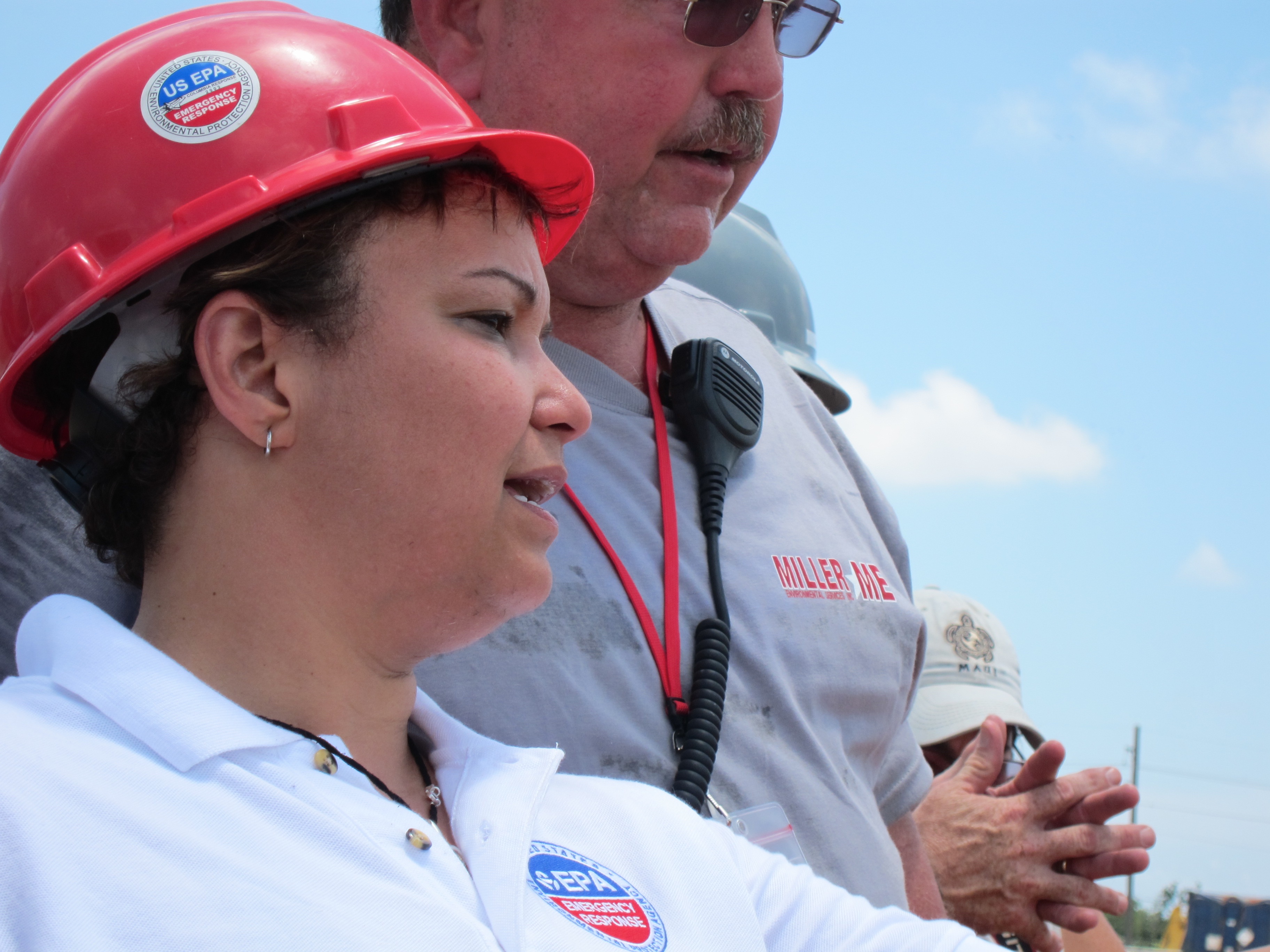
Photo: courtesy of Wikimedia Commons Images, then EPA Administrator Lisa Jackson surveying the oil in the Gulf of Mexico at Grand Isle, La., June 11, 2010, EPA photo.

Friday, February 10, 2017

Six years after BP oil spill, dolphins, fish and corals inspire restoration 

The following article ran on Examiner.com on the sixth anniversary of the BP oil spill, April 20, 2016
Six years ago today, April 20th, TV viewers nationwide turned on the news to see a horrific site: footage of a fire on a rig in the Gulf off the Louisiana coast. The BP oil "spill" had begun, and at the time, no one would have imagined it would take 87 days to cap the Macondo well.
Twelve workers on the Deepwater Horizon rig died that day. For their families, today is a sacred and painful reminder that the errors made leading up to the spill are deeply personal. There were also several serious injuries, and countless illnesses tied to the catastrophe.
Beyond the human tragedy, which included individuals still suffering health effects from working on a Vessels of Opportunity boat that would prove cruelly and ironically named, respiratory illnesses, kidney problems, weight loss, and mysterious rashes would fill their family photo albums.
The tragedy of that day doesn't just include the oil. The dispersant, so called Corexit from the UK - again, ironically since BP stands for British Petroleum - was airdropped by the truckload on Barataria Bay and throughout the gulf.
I spoke to Ocean Conservancy's Bethany Kraft, Director of their Gulf Restoration Program, who said this week that while scientific studies have been and are being done on dispersant effects, largely, at this stage, it's tough to parse what damage was done by them versus the oil.
"I think the jury is still out on that," Kraft said. "In the early days (of the spill), some decisions were made - it was a trade-off, because had all that oil reached the coast, it would have been an environmental and public relations disaster on multiple fronts. It would have been a PR disaster for the government and for BP."
Her concerns right now are numerous. Early restoration projects have begun, even as the bulk of the BP billions won't roll out until next year. Projects currently underway include a seagrass restoration project in Florida; a loggerhead, green, and Kemp's Ridley turtle project in Texas that seeks to offset bycatch by way of trawling with gear improvements and increased monitoring; and a Florida-based fishing gear conversion project that will help bluefin tuna fishermen.
Her overarching concern is addressing this question: "How do we put together the suites of programs in an order and in places where they will reap the most benefits?" She said, too, that it is critically important that as ecosystem restoration goes into overdrive that the science leads, not politics or personalities.
From dead corals to dead turtles, dolphins who give birth to premies who wash up dead on Gulf shores, to deep concerns about the health of the ecosystem and human residents, the legacy of all that oil and Corexit will last for decades, maybe centuries.
And the fix can't be myopic. For example, when addressing a watershed issue, look too at oyster issues and fisheries, helping the oyster harvest and shoreline protection, said Kraft.
Ironically again, had the spill not occurred, the coastal erosion issues are among many preexisting problems funded by the BP dollars approved by Judge Carl Barbier in the New Orleans federal courthouse. Even so, the funds are "a drop in the bucket in terms of what our needs are," Kraft said.
Are there any positives in the Gulf six years following the disaster? She said yes.
"I think we learned this ecosystem is resilient, even though any rubber band eventually loses its elasticity and breaks," she said. "It is reassuring in some ways, and one thing the spill did do was catalyze cooperation across the region like we haven't seen before."
However, she said with a dark laugh, "it's a really dumb business model to get hooked on."
PHOTOS: Top, the author on a boat in Barataria Bay, early April, 2013; Bottom, via Wikimedia Commons Images, Department of the Interior - June 30, 2010. Birds Prepared for Release at Fort Jackson Wildlife Rehabilitation Center, CC BY-SA 2.0, https://commons.wikimedia.org/w/index.php?curid=45431346

Friday, December 16, 2016

Gulf Coast Ecosystem Restoration Council approves plan to restore Gulf

The Gulf Coast Ecosystem Restoration (RESTORE) Council approved its updated Comprehensive Plan to restore Gulf Coast ecosystems "and their natural resource dependent economies" it was announced today in a press release.
Kara Lankford, Interim Director of Ocean Conservancy’s Gulf Restoration Program, said in a statement:
"Ocean Conservancy is pleased to see the Gulf Ecosystem Restoration Council renew their commitment in this updated plan to using the best available science when selecting projects to restore the Gulf. This road map for comprehensive restoration of the Gulf ecosystem is a critical foundation piece to ensure a science-based, holistic approach."
The Council, in its report, says that "Gulf restoration funding is distributed among a number of entities and programs, each with its own set of guidelines and decision processes." As anyone trying to untangle red tape knows, what matters is who gets paid and when.
The Clean Water Act penalties resulting from the spring 2010 BP/Deepwater Horizon oil disaster are allocated as follows: - 35% allocated for ecosystem restoration, economic development, and tourism promotion, distributed to all five affected Gulf states (Florida, Alabama, Mississippi, Louisiana, and Texas); - 30% for what are called "Council-administered restoration activities"; 30% to the states based on impact (i.e. Louisiana was hit the hardest as it was closest to the April 20, 2010 spill); -2.5% for research administered by the National Oceanic Atmospheric Administration (NOAA); and 2.5% administered by the U.S. Treasury for Gulf research programs.
Read about the Comprehensive Plan
here
. Photo: Wikimedia Commons images; by Petty Officer 2nd Class Justin Stumberg, from www.defense.gov/photoessays/photoessayss.aspx?id=1667

Tuesday, August 23, 2016

Gulf environmental groups respond positively to update of restoration plan

Today, the Gulf Coast Ecosystem Restoration Council published an update of its Comprehensive Plan, worth billions, to restore the gulf post-BP oil spill. It augments the original comprehensive plan approved two years earlier.
One of the highlights of the report was that the Council is affirming its commitment to incorporate the best available science, which they note "will evolve over time" and with "changing conditions." One example of a science-based funding priority is developing "science tools to support freshwater inflow restoration" and prioritizing future conservation. Further, the Council is committed to studying the Lower Mississippi River to "support more holistic river management."
The plan's reaffirmation of the Council's commitment to science-based and other funding priorities is consistent with Congressional decree
: projects that are "projected to make the greatest contribution to restoring and protecting the natural resources, ecosystems, fisheries, marine and wildlife habitats, beaches, and coastal wetlands of the Gulf region;" large-scale projects to restore and protect natural resources, ecosystems, fisheries, marine and wildlife habitats, beaches and coastal wetlands; projects contained in existing Gulf Coast State comprehensive plans for restoration and protection of the aforementioned; and projects that restore long-term resiliency of the region's ecosystem, fisheries, and the like.
Collin O’Mara, president and CEO of the National Wildlife Federation, said of the update: “For wildlife in the Gulf of Mexico, the Deepwater Horizon disaster is not over. More than six years after the well was capped, dolphins are still dying, corals are still damaged, and sea turtles are still struggling to nest. The comprehensive plan as updated would help ensure billions of dollars are spent well on restoring the Gulf. We’re pleased with many elements of the draft—particularly the emphasis on coordination at all levels and the support for efforts at a scale that will deliver cumulative benefits to the Gulf of Mexico.
And Kara Lankford, interim director for Ocean Conservancy’s Gulf Restoration Program, said in a written statement: "
“The Gulf Coast Ecosystem Restoration Council is headed in the right direction, and we think this updated plan represents progress. This plan update wasn’t due until 2018, so the Council is ahead of schedule. The Council has a huge task ahead to help restore the environment of the Gulf region. Commendably, they have committed to restoring the Gulf ecosystem by working in a more holistic fashion, rather than state by state, or agency by agency. Dolphins and many other Gulf wildlife swim across state lines, and that is why it is necessary for Council members to work together to restore the Gulf ecosystem as a whole. Likewise, we’re pleased to see the Council include a renewed commitment to updating and improving how science will be utilized in its project selection processes.”
The Council will also hold a number of public and Tribal meetings across the Gulf to hear from the public and Tribes regarding this update. The locations, dates, and times for the public meetings can be found at RestoretheGulf.gov.
Caption: By U.S. Fish and Wildlife Service Southeast Region - Oil arrives on Bon Secour (La.) Uploaded by AlbertHerring, CC BY 2.0, https://commons.wikimedia.org/w/index.php?curid=29827305

Saturday, July 11, 2015

Five years writing about the Gulf of Mexico oil spill, and far more remains to be said.

When the Apr. 20, 2010 BP oil spill made the news that evening, this reporter didn't think too much of it. I remember looking away, figuring it was a small fire that would probably end within hours. But that was not to be. It soon became apparent that the deaths of 11 good men who worked on the rig would besmirch BP's name in a way no bad PR ever could. And as if that wasn't bad enough, the oil bled for 87 days despite numerous attempts by Admiral Thad Allen and team to cap the Macondo well. When it was finally shut down July 15, 2010, the spin was that all was well: many of us knew otherwise. Thousands of birds, marine life, marsh areas and humans were impacted in a way no other U.S. environmental disaster's ever pummelled us. On July 10 of that year, I began reporting for Examiner (some call it "blogging") because I wanted to keep covering this story as it happened. As a freelance writer, which I've enjoyed pretty much full-time since 2008, and part-time off and on since college, I nevertheless spend many hours/days/even months waiting for editors to reply to pitches. I knew that after a couple of unsuccessful queries, this story just didn't have time to percolate in the Manhattan offices of busy editors who were looking for angles and news "hooks." By January of 2011, I interviewed Dr. Samantha ("Mandy") Joye, a Univ. of Ga. biogeochemist who made national news for telling it like it was out in the Gulf. She'd been deep diving there long before anyone though of BP other than when they got gas. I felt fortunate to get this noted scientist to talk to me, even if it meant an e-mail conversation. Soon after receiving her answers back, I was in for a surprise: her staff asked if I'd join Justin Gillis of The New York Times, Richard Harris of NPR, and a CNN producer down in Georgia in a couple of weeks to speak about how we could better communicate after disasters such as these, as part of a symposium called "Building Bridges in Crisis." Of course I would, and looking back, it was a definite highlight of my career. Even then, when giving my speech about the dead dolphins, the turtles washing up on shore, the sick people working on the Vessels of Opportunity, I knew that we could easily meet back in a year or two or even 10. I knew the Gulf of Mexico was a mess and this story was far from over. Sadly, I was right. Further, Corexit dispersants doused by the gallon-full and airdropped along the Gulf reached an estimated 1.84 million gallons. These dispersants aren't even used in the very country in which they're manufactured, England; and since the spill, California's successfully passed legislation to block such reactions to spills. (Good timing considering the recent Santa Barbara spill.) In 2012 I would write a story for AARP on Dr. Sylvia Earle, the National Geographic Explorer-in-Residence who keynoted at the UGA conference. Dr. Earle talked to me at length about the dangers of Corexit, how she spoke before Congress on this, and how "out of sight does not mean out of mind." She knew only too well, as would noted toxicologist Riki Ott, how Corexit sickened the dolphins, turtles and precious other sea creatures and birds in the Gulf, how it made everyone and everything worse. Its only "benefit" was that it kept a lot of the oil from travelling further into the marshes, while along the way choking the life out of fish and birds feeding innocently at Barataria Bay on their morning dispersant-soaked worms. Here are five of what I consider my most impactful posts concerning the wildlife and marine life affected by the BP oil disaster. These stories stand apart from the equally horrific blight that has affected the thousands of Gulf residents, especially those who lived or worked in Zone A (the most affected areas), following the spill. 1. Dr. Joye explains why we owe it to the ecosystem to learn from the oil spill: Dr. Joye was one of the first scientists to speak the truth about what was going on on the sea floor. In further months she'd draw a link between the spill and methane pollution down deep into the water column. In our Jan. 6 e-mail interview, she told me: "NOAA claims that 75 percent of the oil from the blowout is 'gone.' I would argue that a lot of that oil has 'landed on' the bottom…it’s not 'gone' and it’s still having an impact, a very negative one!, on the system. Why is this important? Because we need to know how much oil is down there, where it is and what impacts it’s having. This is critical because understanding/documenting the impacts and the system’s recovery from those impacts is essential for truly understanding the repercussions of this blowout." 2. Hundreds of oil-impacted turtles and dozens of dolphins have perished: When I published this story July 29, just a few months after the spill, we were just beginning to grasp the huge disaster this was and how it affected the beautiful sea creatures who grace the Gulf. I reported that, "Seven hundred seventy-seven dead or injured turtles have been documented to date," according to Oceana. Elizabeth Griffin Wilson, marine wildlife scientist and fisheries campaign manager, told me: “No one really knows how many [turtles have died]. That’s one of the big challenges with sea turtles. Once they’re out there in the water they’re really hard to find.” Of the 777 reported by “Unified Command” – which provides Oceana with a daily estimate of wildlife affected by the spill – 283 of those were collected alive and 494 were dead. 3. Ulcerated blue crabs found in Gulf, at Mississippi Sound: When I published this story, we were just beginning to grasp the huge impact the spill had on the shellfish and other marine creatures in the Gulf. Here it was, over two years after the spill, and Lorrie Williams was taking photos of ulcerated crabs along the beach at Gulf Springs, Miss. Ironically, the photographer was and remains suffering as much as the crab in the photo: she's endured pancreatitis, lung polyps, extreme weight loss and other health effects as a result of her and her husband's work out on the waters. 4. Animals keep dying, so where are the official wildlife reports?: It's now been well documented that we'll never know the exact or even near exact numbers of brown pelicans, herons, and other birds that died as a result of the disaster. At the time I published this, it would have boggled everyone's minds to know that Audubon, a couple years later, would cite that over a million birds had died as a result of the Deepwater Horizon/BP oil disaster. 5. BP oil spill 5 years later: NWF cites record numbers of dead turtles, dolphins: The National Wildlife Federation (NWF) reported in "Five Years and Counting: Gulf Wildlife in the Aftermath of the Deepwater Horizon Disaster," 20 different species have been gravely impacted by the spill. (Note, these are just the ones in the report.). Namely, dolphins on the Louisiana coast were found dead at four times historic rates in 2014, and there is increasing evidence that these ongoing deaths are connected to the Apr. 20, 2010 BP oil spill; 2010 and 2011 had the lowest numbers of young red snapper seen in the eastern Gulf fishery since 1994; coral colonies in five separate locations in the Gulf—three in the deep sea and two in shallower waters—are showing signs of oil and or some mixture of oil-and-Corexit damage; and prior to the spill, the number of endangered Kemp’s ridley sea turtle nests found annually was accelerating, but since 2010 the nests found annually have declined. BP recently settled in principle with the U.S. Dept. of Justice for $18.7 billion for breaching the Clean Water Act and Oil Pollution Act; this is irrespective of the multi-billion-dollar criminal fines it incurred and anything resulting from claimants' medical and other damages.
April 20, 2010 Source: (Via Wikimedia Commons Images) U.S. Coast Guard - 100421-G-XXXXL- Deepwater Horizon fire Author Unknown

Thursday, September 26, 2013

BP heads back to court Monday: Wants to downplay amount of oil that spewed into Gulf

This morning, the National Wildlife Federation e-mailed a press release, which I received. They remind that on Monday, BP heads back to court "to try and convince U.S. District Judge Carl Barbier that the company’s Deepwater Horizon well spewed just 2.45 million barrels of crude oil into the Gulf of Mexico—significantly less than the 4.1 million barrels the government’s team of scientists has estimated."

The NWF, rightly, points out that BP "has a long history of downplaying the size of the spill—the company pled guilty to lying to Congress on this very topic."

Any decrease in the official estimate of the volume of the spill would greatly benefit BP’s bottom line, NWF says. "Under the Clean Water Act, BP will have to pay anywhere from $1,100 to $4,300 per barrel spilled, depending on the degree of negligence found.

Reducing the estimated size of the spill will also hurt the outlook for the Gulf of Mexico. Thanks to the RESTORE Act, 80 percent of the Clean Water Act fines will be sent back to the region affected by the disaster."

Here are some of the areas that NWF urgently wants addressed:

  • Deep sea impacts: Just yesterday, the National Oceanic and Atmospheric Administration (NOAA) released a study indicating that it may take decades for the deep sea ecosystem to recover.
  • Dolphin deaths: NOAA’s investigation into the unprecedented dolphin and whale mortalities in the Gulf of Mexico—particularly bottlenose dolphins—continues.
  • Oiled shorelines: In June, a 40,000-pound tar mat was found off a Louisiana barrier island and 200 miles of the Louisiana coast remain oiled. Tar balls from the disaster regularly foul the beaches and coastlines of Florida, Alabama and Mississippi.
  • Blue crabs: Crabbers from Florida to Louisiana are complaining about low crab catches this year and scientists are investigating the oil disaster as a potential cause. 
NWF writes that BP is "...trying to walk away from the Gulf with as little liability as possible, most notably in its attempts to limit settlement payouts to businesses harmed by the spill."

Monday issues in the second phase of the trial, which will determine the company’s civil liabilities for violating the Clean Water Act, the Oil Pollution Act and other federal environmental laws.

The Clean Water Act civil fines are meant to be punitive, while the Oil Pollution Act requires that BP pay to repair the damage to the Gulf.

For more information, please click here.

Bold marks/hyperlinks are largely those of the writer's.
Note: an earlier version of this blog incorrectly listed the NWF as the National Fish & Wildlife Federation.
Caption for photo: An egret in the Gulf of Mexico was oiled because of the BP spill. Credits: U.S.Fish & Wildlife Service

Thursday, May 23, 2013

Gulf Coast Ecosystem Restoration Council releases draft of restoration plan

Photo: Laurie Wiegler, 2013. David Muth of the National Wildlife Federation, Bay Jimmy, La.

At just after 3 pm CT today, the Gulf Coast Ecosystem Restoration Council sent out a press release stating that they'd "marked significant progress today with the public release of the Draft Initial Comprehensive Plan: Restoring the Gulf Coast’s Ecosystem and Economy (PDF 621kb) and accompanying Draft Environmental Assessment (PDF 1.1 MB) for formal public comment".

The draft provides a framework, they said, to "implement a coordinated region-wide restoration effort in a way that restores, protects, and revitalizes the Gulf Coast region following the Deepwater Horizon oil spill"

The plan:

  • establishes overarching restoration goals for the Gulf Coast region;
  • provides details about how the Council will solicit, evaluate, and fund projects and programs for ecosystem restoration in the Gulf Coast region; 
  • outlines the process for the development, review, and approval of State Expenditure Plans; 
  • and highlights the Council’s next steps.  
The Council expects to release its final plan this summer, according to RestoretheGulf.gov, which issued today's press release.

The Council is hosting a series of public engagement sessions in each of the five impacted Gulf states next month. The 30-day formal public comment period for the Draft Plan and associated documents began today, May 23, and ends June 24.

Public meetings to discuss the Draft Plan are scheduled for the following dates and locations:
  • June 3, 2013: Pensacola, Fla.
  • June 5, 2013: Spanish Fort, Ala.
  • June 10, 2013: Galveston, Tex.
  • June 11, 2013: Biloxi, Miss. 
  • June 12, 2013: Belle Chasse, La.
  • June 17, 2013: St. Petersburg, Fla.
To view or provide comments on the Plan and associated documents and to get additional details on the upcoming public meetings as they become available, please visit www.restorethegulf.gov.

Comments can be submitted here: http://parkplanning.nps.gov/commentFormBasic.cfm?documentID=53621

Background
The Council was established by the Resources and Ecosystem Sustainability, Tourism, Opportunities Revived Economies of the Gulf Coast States Act of 2012 (RESTORE Act), to help restore the ecosystem and economy of the Gulf by developing and overseeing implementation of a comprehensive plan and action.

To read more stories about the Deepwater Horizon oil disaster and its aftermath, please click here.